I have always been very interested in the subject of “dreams”. Dreams are a phenomenon that is very worth exploring: within dreams, logic is dismantled, and time and space become disordered; they display people’s deepest subconsciousness and emotions in a raw and unhidden way, forming a very sharp contrast with the ordered, regular and rational reality.
“How to Feed a Dream” was my first attempt at artistically exploring dreams. I tried to present this short film without dialogue, not using language to tell the story, but instead using visuals, music, actions and narrative methods to express emotions. This was undoubtedly also a challenge for me. How could I tell the story clearly without using any language to explain it? I constantly tried to communicate with others, finding the unclear points in the story and gradually adjusting my animatic.
Controlling the rhythm of storytelling and emotional transitions was extremely important. The emotional progression of the story follows a curve of low → high → lowest → highest, corresponding to the protagonist’s daily nightmares → beginning to have beautiful dreams after picking up the small creature → the creature being consumed by nightmares → the two facing the nightmares together, with the protagonist reconciling with herself. Clear turning points and rhythm are the prerequisite for telling a story well.
In addition, because there was no dialogue, many details and settings in the story were difficult to express clearly. For example, I tried using black fog to represent bad dreams, and white light particles to represent beautiful dreams, but simply extracting these elements could not make what I wanted to express clearer. After adjustments, not only did I add scenes of the creature absorbing dreams in reality during the process of nightmares transforming into beautiful dreams, but I also focused more on adjusting the creature’s emotions: from calmness to exhaustion → and then feeling relieved because of the protagonist’s happiness.\
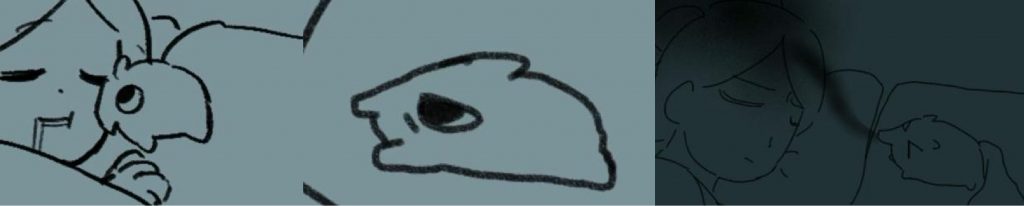
Besides visuals, music was also a very important part. This was my first time trying to communicate with a composer in order to build the music of the story. At first, I divided it into four parts according to the emotional progression of the story: ordinary daily life, beautiful dreams, the creature mutating (becoming sick), and the final emotional release. After my initial communication with the composer, I gained new inspiration during conversations with Rory, which was adding a specific melody to the nightmares. This not only made the audience understand the emotional progression of the story more clearly, but also better unified the musical storytelling of the whole film.
I think this was a very difficult but extremely interesting experience. I faced many problems, but continuously tried to revise and improve the work through communication with others. I began to understand that animation is not only about making the audience understand the story, but also about making the audience feel emotions. I hope I can continue improving in this area.
Leave a Reply